Briefly
Yes. Wool is one of the hardest common fibers to ignite. It needs about 1,058°F (570°C) to catch, and 25.2% oxygen to keep burning, more than the roughly 21% in air (Silver Bobbin, Is Wool Flammable?; Textile School, Is Wool Fire Resistant?). In your pillow, the fill tends to char and go out instead of flaring up. That does not make the pillow fireproof. The cotton cover catches fire more easily, and federal mattress fire rules do not cover bed pillows.
This guide is for: people who have seen "naturally flame resistant" on a wool pillow and want to know what the claim covers.
Key Takeaways
These three points carry the whole answer: how wool behaves, what sellers publish, and which rules reach a bed pillow sold in the US.
- Wool needs 25.2% oxygen to keep burning, more than the roughly 21% in ordinary air, so you can expect it to go out once the flame is gone (Textile School, Is Wool Fire Resistant?).
- Of 6 wool pillow seller pages we read, 5 say the wool resists flame and 0 name a fire test that the finished pillow passed.
- Cotton, the usual cover fabric, ignites at 255°C, under half the heat wool needs, and the CPSC's mattress rules exclude pillows (Textile School, Is Wool Fire Resistant?; CPSC, Mattresses FAQ).
Is wool naturally flame resistant?
Yes. Wool needs more heat and more oxygen to burn than most fibers, and it chars and swells instead of melting when a flame reaches it.
Wool resists flame with no added chemical. The resistance is built into the fiber. Australia's science agency CSIRO lists the reasons: a high ignition temperature, a high nitrogen content, a low heat release, and a char that insulates the fiber and stops the flame spreading (Textile School, Is Wool Fire Resistant?). Its limiting oxygen index is higher than the share of oxygen in ordinary air.
That index is the smallest share of oxygen that will keep a sample burning. If a fiber's index sits above the share in air, you can expect it to stop burning once you take the flame away (Textile School, Wool Fiber). Wool's index sits above that line.
When a flame reaches wool, you see it char and swell rather than melt and drip. The char works as a shield for the fiber underneath it. That is not how a polyester fill behaves, as the fiber table further down shows.
Because the resistance comes from what the fiber is made of, you are not relying on a coating that could wear away. Wool still burns in a strong enough heat source, and the wool trade's own figures say only that it does not normally support flame. So "resistant" never means "fireproof." Treat a wool pillow like any other bedding near a candle.
What do wool pillow sellers say about flame?
Most seller pages we read say the wool resists flame. None of them names a fire test that the finished pillow itself has passed.
We read 6 seller pages for wool bed pillows on November 13, 2026, and sorted each one by what it says about flame. All of them are the sellers' own product or collection pages, linked in the table. We counted what the pages print.
| What the page says about flame | Pages | Seller pages read |
|---|---|---|
| The wool resists flame; no test named for the pillow | 5 | Naturepedic, The Wool Room, The Futon Shop, Home of Wool, The Wool Bed Company |
| Only that no flame retardants were added | 1 | Natural Linens, Holy Lamb Organics pillows |
| A flammability test or result for the finished pillow | 0 | None of the pages read |
5 of the 6 pages say the wool resists flame. 0 of the 6 name a fire test the finished pillow passed.
You should not read the missing test as a warning sign. A bed pillow has no federal flammability test to pass, as the section on US rules explains below. The gap still tells you what each claim rests on. Each page describes wool as a fiber. That is accurate. None of them reports a result for the pillow you would buy. If a test result matters to you, ask the seller in writing whether the finished pillow has been tested, and by whom.
How does wool compare with cotton and polyester near a flame?
Wool ignites at a far higher heat than cotton, needs more oxygen than air holds, and never melts the way polyester and nylon do.
Next to the fibers most pillows are made from, wool stands apart on both measures that matter here. The figures below come from one IWTO fiber table, credited to Australia's research agency CSIRO, so you are comparing the three fibers on one footing (Textile School, Is Wool Fire Resistant?; Textile School, Wool Fiber).
| Fiber | Ignition point, °C | Limiting oxygen index | Melts? |
|---|---|---|---|
| Wool | 570 to 600 | 25.2% | No |
| Cotton | 255 | 18.4% | No |
| Polyester | 485 to 560 | 20 to 21% | Yes |
Source: IWTO figures, credited to CSIRO, as reported by Textile School. Temperatures are in Celsius, as IWTO publishes them.
Cotton and polyester both sit below the oxygen share of air, so once lit, either one can keep burning in your bedroom. Wool sits above that line. That gap is the main reason wool is known for resisting flame.
The last column matters because your face rests on the pillow. Polyester fill can melt and drip. Wool chars in place. Cotton is the odd one out: it does not melt, but it ignites at under half the heat wool needs. You will see cotton again in the section on covers, because cotton is what most wool pillows are wrapped in.
What is the difference between flame resistant, flame retardant, and fireproof?
Flame resistant means hard to ignite and slow to spread. Retardant usually means a treatment. Fireproof means it cannot burn at all.
Sellers use these three words as if they meant one thing. They do not. Flame resistant describes a material that is hard to ignite and slow to spread flame, which is what IWTO's fiber figures show for wool. Flame retardant usually refers to a chemical added so that something resists flame. Fireproof means a material will not burn at all. Wool does not meet that standard.
Wool can be treated with a retardant too. A zirconium treatment called Zirpro adds to wool's resistance without changing its natural properties, and it is used where a product must meet a regulated test (Fibre2Fashion, Flame resistance of wool). If you want to know whether a pillow's wool was treated, look for the treatment named on the page, since an untreated fiber needs no such note.
| Word on the page | What it usually means | Fits untreated wool fill? |
|---|---|---|
| Flame resistant | Hard to ignite, slow to spread flame | Yes |
| Flame retardant | A chemical treatment was added | Only if the seller says it was treated |
| Naturally flame retardant | Resistant, with nothing added | Yes, read it as resistant |
| Fireproof | Cannot burn | No |
Table basis: our reading of each term against the sources in this section.
So when you see "naturally flame retardant" on a pillow page, you can read it as "resistant." The word "naturally" tells you the seller is describing the fiber itself, with no retardant chemical sprayed or soaked into it.
Does the shape of the wool fill change how it burns?
It can. Loose, airy fiber lets oxygen reach every strand, and regulators note that open, light textiles burn more readily than dense ones.
How a textile is built changes how it burns, and pillow fill is about as open as a textile gets. Health Canada's industry guide names fiber content, construction, weight and finish as factors in flammability. It also says combustion speeds up when air can move easily through a fabric (Health Canada, Industry Guide to Flammability of Textile Products). It adds that a lightweight fabric tends to burn more readily than a heavier one made from that fiber.
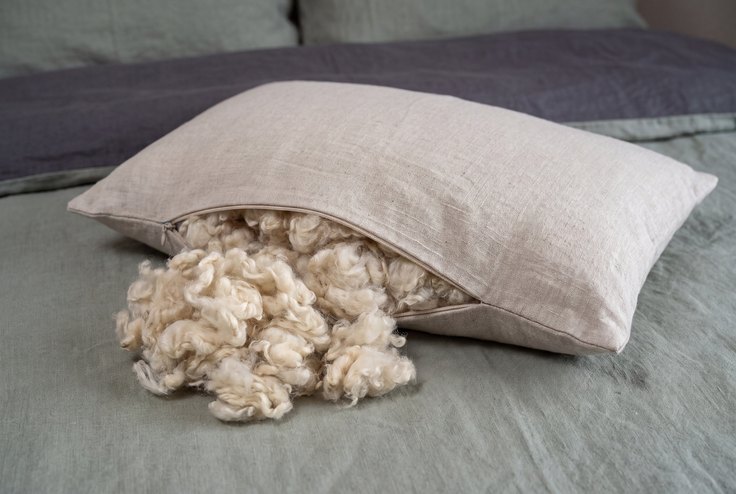
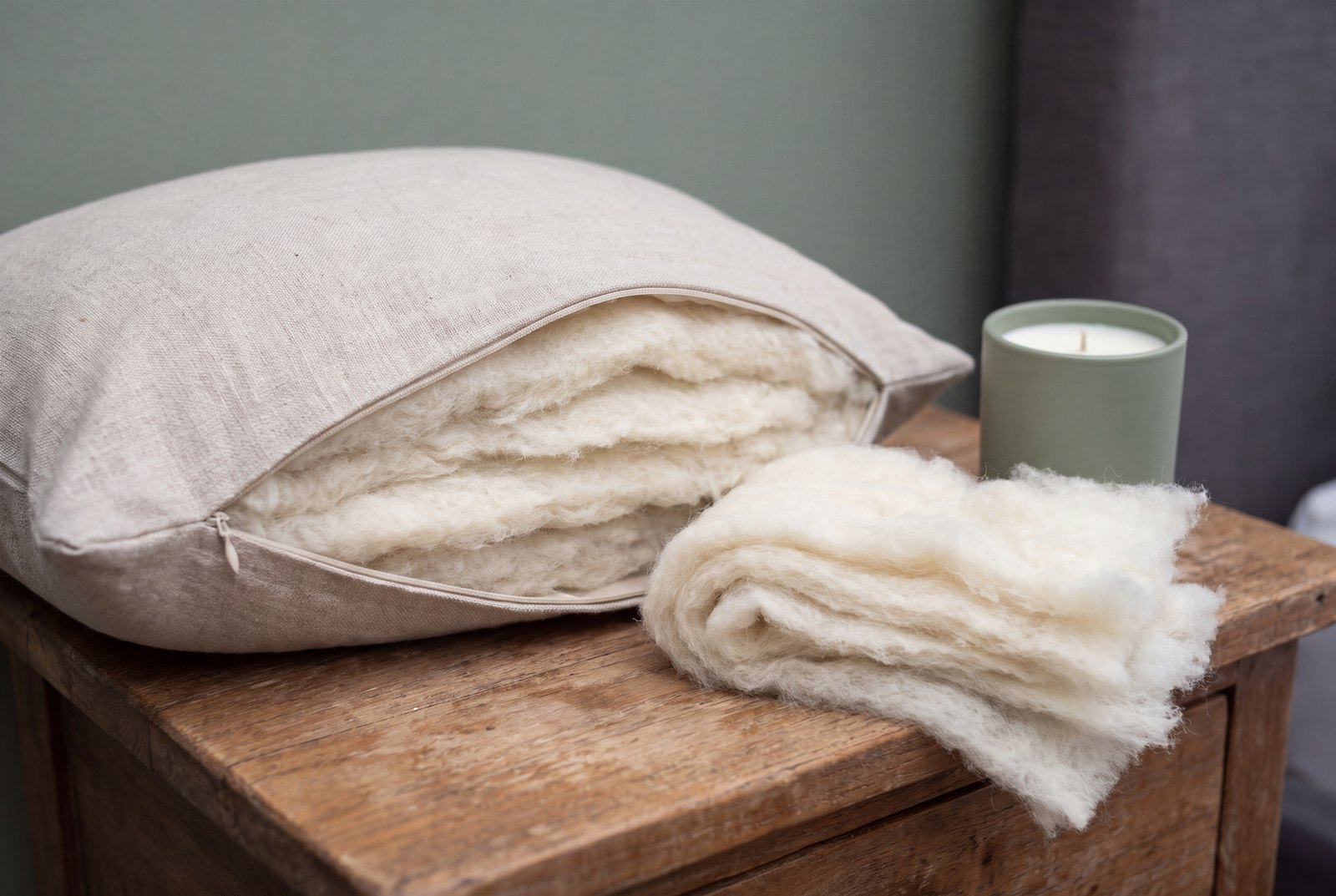
Wool pillow fill is loose fiber with plenty of air in it. That holds whether you buy layered batting, wool balls or shredded wool, and our guide to the three kinds of wool fill covers how they differ in feel. In each case, oxygen can reach far more of the fiber than it could in a tightly woven wool blanket.
You should not assume one fill type is safer than another. We found no published flame test of any of them, so there is no basis for ranking one above another.
The evidence supports only a general rule. An airy wool fill gives up some of the advantage a dense wool fabric has, though the fiber itself still needs more heat and more oxygen than cotton to burn. If you see a claim that one fill shape is the fire-safe choice, look for the test behind it before you believe it.
Does the cotton cover burn more easily than the wool inside?
Yes. The cover on most wool pillows is cotton, and cotton ignites at a much lower heat and needs less oxygen than the wool fill inside.
A flame reaches the cover first, and on most wool pillows you will find the cover is cotton. Naturepedic, for example, lists a cotton encasement around its organic wool fill (Naturepedic, Organic Wool Pillow). The fiber table shows that cotton ignites at a much lower heat than wool and keeps burning in ordinary air.
None of the seller pages we read puts it this way, but a wool pillow is wool inside a cotton cover, and the cover catches fire first. The table below is our reading of each layer against IWTO's fiber figures. It is a judgment, not a test. None of the makers we read publishes anything like it.
| Layer | Usual material | What IWTO's fiber figures suggest near flame | Fire test published for the pillow? |
|---|---|---|---|
| Pillowcase you add | Cotton or a blend | Cotton keeps burning in air once lit | Not part of the pillow |
| Pillow cover | Cotton | Ignites at lower heat, keeps burning | None in the pages we read |
| Fill | Loose wool | Hard to ignite, chars, tends to go out | None in the pages we read |
Table basis: judgment, from the IWTO fiber figures and the seller count above.
This changes how to read the claim. The wool inside may resist a flame, but a flame never reaches your wool first. It has to get through your pillowcase and the pillow's own cover, and both of those burn more readily than the fill they wrap.
Do US flammability rules apply to bed pillows?
No federal mattress rule covers them. The CPSC's mattress standards list pillows among the items they exclude from the definition.
The Consumer Product Safety Commission sets the federal fire standards for mattresses, and pillows fall outside them. The CPSC's definition of a mattress excludes pillows, along with sleeping bags, mattress toppers and water beds (CPSC, Mattresses FAQ). The definition in the regulation itself agrees (16 CFR 1632.1, eCFR).
Most of what you hear about wool and fire comes from mattresses. One federal test checks whether a mattress resists a lit cigarette, and a second is an open-flame test for mattress sets. Some makers pass the open-flame test with a layer of wool under the cover.
One seller states that its mattress meets that standard with organic wool at 1 ounce per square foot and no chemical retardant (Avocado, Green Mattress).
Seat cushions are a separate case. The CPSC says cushions or pillows sold for indoor seating are likely covered by its upholstered furniture rule (CPSC, Upholstered Furniture FAQ). A bed pillow is not seating. So that rule should not reach the pillow on your bed.
That leaves a clear difference for you as a reader. In a mattress, "no flame retardants" means the maker passed a federal test without them. In a bed pillow it is the normal case, because no mattress standard requires a pillow to pass anything.
What does wool's flame resistance mean for safety in a bedroom?
It lowers the odds that the fill feeds a small flame, but the pillow can still burn, so the usual bedroom fire habits still apply.
Fires that start in bedding are among the deadliest home fires. An NFPA study ranked mattresses and bedding second among items first ignited in US home fire deaths. It found that 44% of those deaths came from fires started by smoking materials (NFPA report, via NIST FireDOC).
Wool fill can slow a small flame, but it cannot make your bed safe. The cotton cover, the pillowcase, your sheets and your duvet all burn more readily than wool. So the habits that protect you are the usual ones. Never smoke in bed. Keep candles and space heaters well away from bedding, and keep working smoke alarms near where people sleep. A wool pillow does not change any of that, and you should not treat it as a reason to relax them.
If you chose wool partly to avoid chemical retardants, that reason holds up. Think of the flame resistance as a property the fiber has anyway. It is not a fire safety feature of the pillow, and none of the sellers we read cites a test that would make it one.
Common questions
Short answers to the follow-up questions people ask once they know wool resists flame, each one kept to what the sources support.
Does a wool pillow contain chemical flame retardants?
Usually not. Most wool pillow pages we read say the wool needs no added retardant, and no federal mattress standard requires one in a bed pillow. If the page doesn't say, you can ask the seller in writing.
Will a wool pillow melt if it gets too hot?
No. IWTO's fiber figures list wool as a fiber that does not melt, while polyester does (Textile School, Wool Fiber). Wool chars instead, so you will not get melted fiber stuck to your skin.
Does washing a wool pillow wash out its flame resistance?
The resistance comes from the fiber's own makeup, mainly its nitrogen content, not from a coating. Untreated wool carries no retardant chemical layer that could rinse out into your laundry water or wear off over time. We found no published test of whether a machine-washable treatment changes how wool behaves near flame.
Is organic wool more flame resistant than conventional wool?
We found no source showing a difference. Organic certification covers how the sheep are raised and how the wool is processed, not how it burns, as our guide to what "organic wool" certifies explains.
Can a candle or cigarette set a wool pillow on fire?
It can. A strong enough heat source can ignite wool, and the cotton cover you rest your head on ignites at a far lower heat than the wool inside. Keep candles well away from your bed.
Why do mattress makers use wool as a fire barrier?
A heavy enough wool layer can help a mattress pass the federal open-flame test without added chemicals. Pillows are not held to that test, so you won't find a separate fire barrier inside a wool pillow.
Sources
Here are the pages, papers and shops this wool guide draws on, each named beside the question it answers.
- Silver Bobbin, Is Wool Flammable? (silverbobbin.com), drawn on in the first paragraphs.
- Textile School, Is Wool Fire Resistant? (textileschool.com), drawn on in “Key Takeaways”; “Is wool naturally flame resistant?”; “How does wool compare with cotton and polyester near a flame?”.
- CPSC, Mattresses FAQ (cpsc.gov), drawn on in “Key Takeaways”; “Do US flammability rules apply to bed pillows?”.
- Textile School, Wool Fiber (textileschool.com), drawn on in “Is wool naturally flame resistant?”; “How does wool compare with cotton and polyester near a flame?”; “Common questions”.
- Naturepedic (naturepedic.com), drawn on in “What do wool pillow sellers say about flame?”; “Does the cotton cover burn more easily than the wool inside?”.
- The Wool Room (thewoolroom.com), drawn on in “What do wool pillow sellers say about flame?”.
- The Futon Shop (thefutonshop.com), drawn on in “What do wool pillow sellers say about flame?”.
- Home of Wool (homeofwool.com), drawn on in “What do wool pillow sellers say about flame?”.
- The Wool Bed Company (woolbed.company), drawn on in “What do wool pillow sellers say about flame?”.
- Natural Linens, Holy Lamb Organics pillows (naturallinens.com), drawn on in “What do wool pillow sellers say about flame?”.
- Fibre2Fashion, Flame resistance of wool (fibre2fashion.com), drawn on in “What is the difference between flame resistant, flame retardant, and fireproof?”.
- Health Canada, Industry Guide to Flammability of Textile Products (canada.ca), drawn on in “Does the shape of the wool fill change how it burns?”.
- 16 CFR 1632.1, eCFR (ecfr.io), drawn on in “Do US flammability rules apply to bed pillows?”.
- Avocado, Green Mattress (avocadogreenmattress.com), drawn on in “Do US flammability rules apply to bed pillows?”.
- CPSC, Upholstered Furniture FAQ (cpsc.gov), drawn on in “Do US flammability rules apply to bed pillows?”.
- NFPA report, via NIST FireDOC (firedoc.nist.gov), drawn on in “What does wool's flame resistance mean for safety in a bedroom?”.